A question that sounds trivial
Who is speaking on your website? The question sounds trivial. Your company, of course. But which one exactly: the group, the subsidiary, the brand, the former name still used on half the pages? For humans, this is usually clear from the context. For a machine that must attribute services, references, and certificates to a sender, it is the first and most important question.
We wanted to know: How often do websites leave it open who is speaking—and what does an AI make of it?
An estimate we couldn’t maintain
Our first answer was an estimate from memory: out of about fifty domains we had looked at, only a single one had been unambiguous. A powerful statement. Before using it, we recounted—audit folder by audit folder.
33 domains with documentation were verifiable. 23 remained evaluable according to strict criteria. In 18 of these 23 domains, it was unclear who was speaking: which entity, which brand, which name. That is 78 percent—high, but significantly less dramatic than our estimate. And it is our own sample from various industries, not a representative rate. Since then, we only count what we can prove.
On the list: ourselves
Among the 18 unclear domains were two of our own. On aivis-os.com, the legal notice named the supporting GmbH, while the privacy policy named a natural person. And a price appeared in two versions on two pages. We corrected both. However, the sender question will only be fully resolved for us with the planned dedicated entity for Aivis-OS; until then, another entity acts as the carrier—as stated on the website and in the data. The episode reminded us why we audit our own website just like those of our customers: such contradictions do not arise from negligence, but because over time many pages are written by many hands and no one lays them all side by side.
The patterns among the others are similar: a corporate group with several entities, none of which share the brand name. An industrial company with three company names without an explained relationship. An organization after a renaming where the old name appears more often than the new one. Without clarity regarding the sender, it is unclear which company a service, reference, or certificate belongs to.
What an AI makes of it
Even with a clear name, statements can contradict each other. For a large organization, we compared an AI research report against its website, statement by statement. Where the website was unambiguous, all 13 checked statements were correct. Where it contradicted itself, eight of 13 were vague, outdated, or wrong. One example: an older announcement appeared in the AI response as a valid resolution, while the page in question remained active.
This is a single test case, not a controlled study. But it illustrates the problem: where the website offers multiple versions, the AI may reproduce the wrong one.
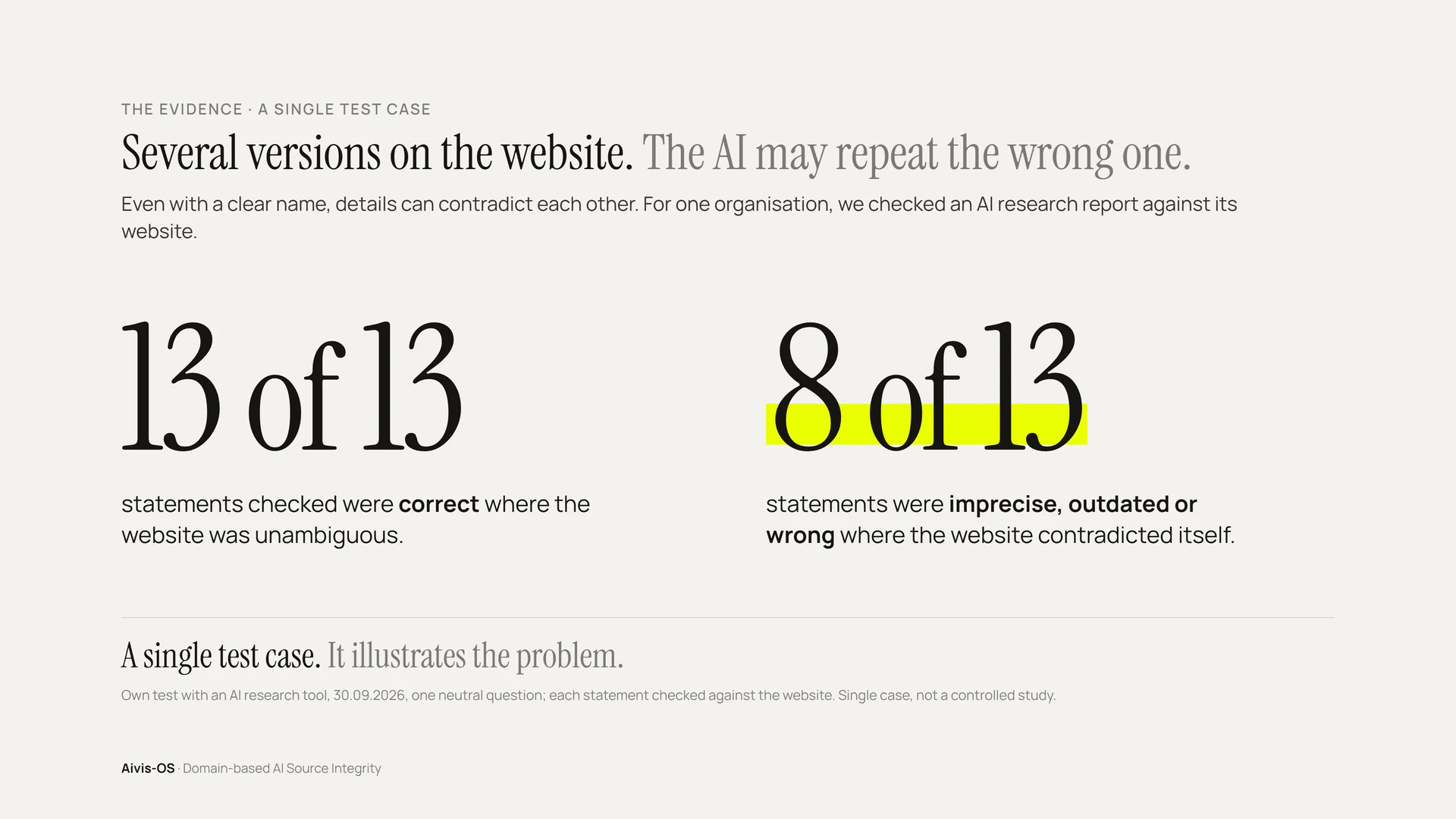
In-house test, 2026-09-30: a neutral question to an AI research tool; each statement cross-checked against the website.
A lesson about our own work
Our audit also has blind spots. In one audit, we considered a missing registry number to be a finding. It was live in the footer—our text extract of the website simply hadn’t included the footer. In another case, two findings regarding the sender were dropped for the same reason. Since then, we verify every identity finding on the live site before it enters a report.
For your website, the conclusion is the same as for ours: more content does not solve the problem. The first step is to clarify the sender and decide, for each contradiction, which version applies. Why structured data alone cannot achieve this is described in the article “When structured data publishes contradictions”.
Conclusion
Before a machine can understand what you offer, it must know who is speaking. In our sample, this was unclear for 18 out of 23 domains—including two of our own. Where the website is unambiguous, the AI reads accurately. Where it hesitates, the AI hesitates. Or it chooses—and not necessarily correctly.
More articles
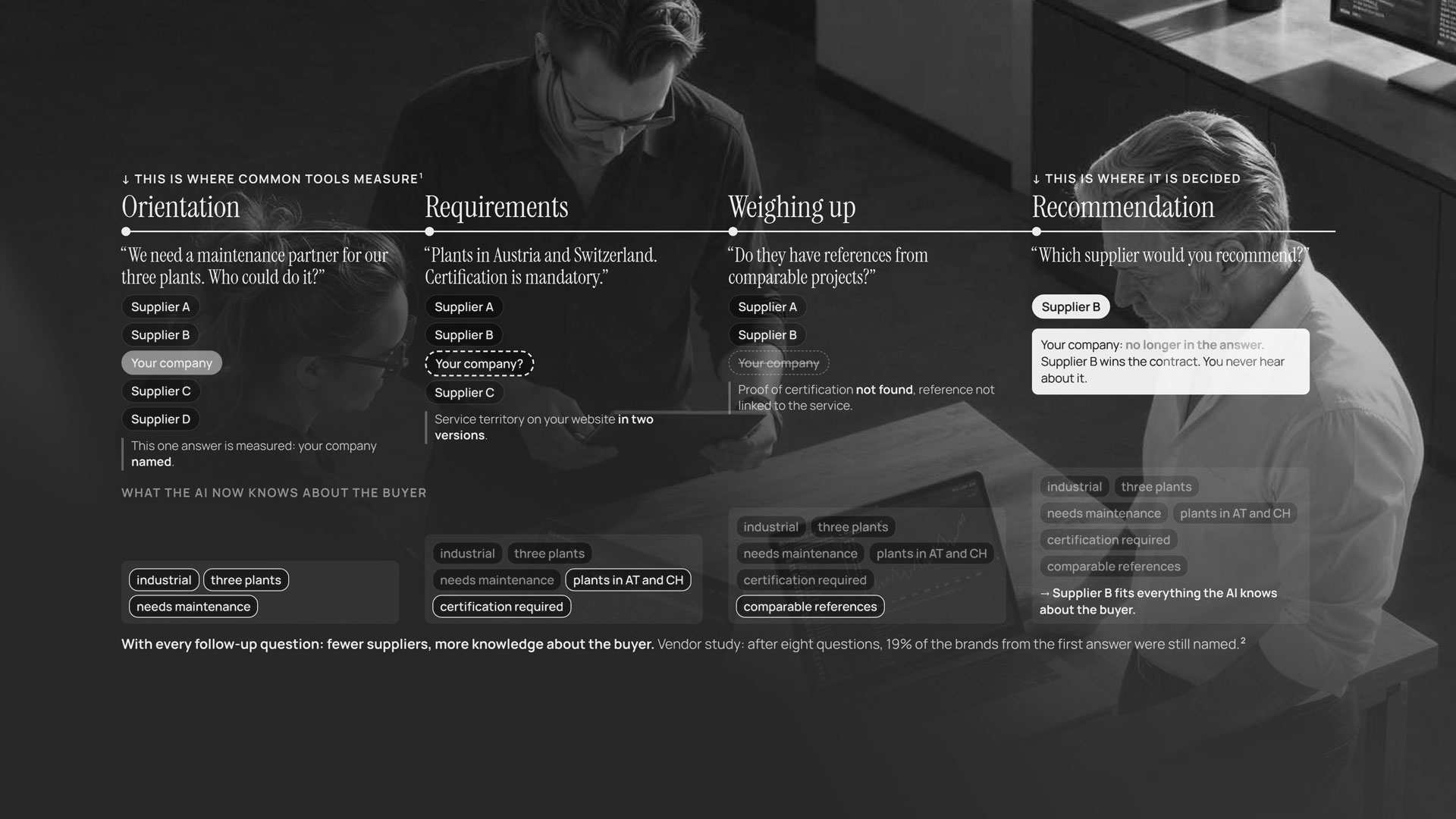
Mentioned in the first response, no longer in the last

Why AI Monitoring Stops After the First Question

Known or Suitable: What Differentiates Established Companies and Specialists

When Structured Data Publishes Contradictions

Who’s speaking? What machines learn from your website today

Source First, Then Echo

Your people decide. They don’t type.

Domain-based structured data: eight benefits

Acceptance, Not Report: Objective, Boundary, and Completion
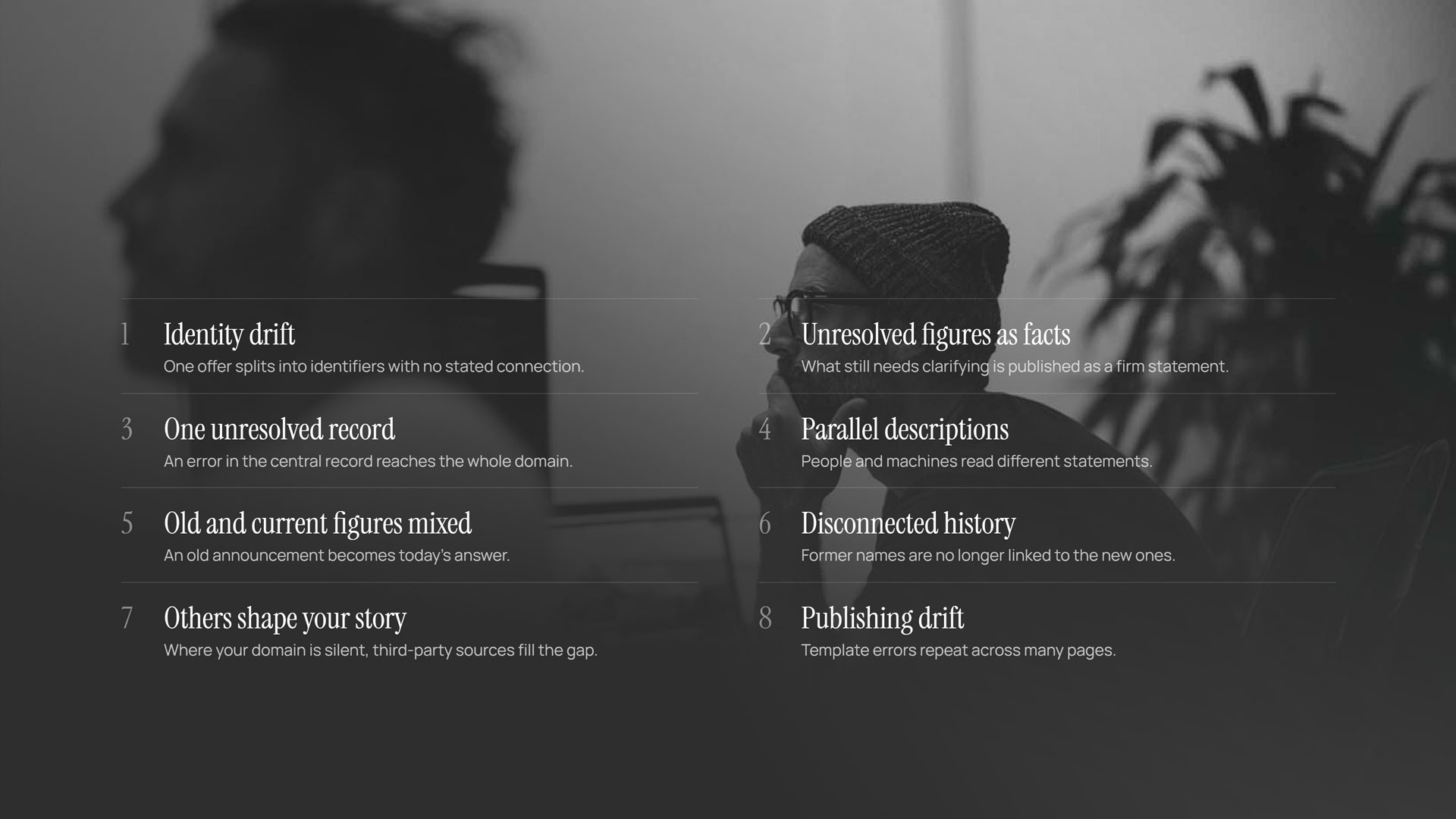
Page-generated data: eight risks
FAQ
Why is the question “Who’s speaking?” so important?
Because services, references, and certificates must be attributed to a company. If multiple legal entities or names are involved, that attribution becomes uncertain.
How meaningful is 18 out of 23?
It is our own sample from audits across different industries, not a representative industry rate. It shows that the pattern occurred frequently in our audits—including on our own website.
Does the test with 13 statements prove that AI makes mistakes?
It shows, in a single case, that contradictory statements can be reproduced as vague, outdated, or wrong. No general error rate can be derived from this.
Contact us to discuss your project or simply get our opinion.