The first response feels like a success
You ask an AI about providers in your market, and your name is in the response. That is a good feeling. Many reports on AI visibility stop right here: mentioned, therefore visible.
But a buyer rarely asks just once. They describe their situation, state requirements, and ask for proof. This led to the question of this article: Is a mention in the first response already a recommendation – and what happens to it when the buyer asks follow-up questions?
Where we encountered the question
In mid-October, Norbert Kathriner, who develops Aivis-OS, had a long conversation with an AI. One observation stuck, which became the starting point for this series: almost everything the industry measures regarding AI visibility concerns the first response. But the decision is made later.
Shortly before, we had conducted a small sample for a provider in the travel market: three questions, asked in the same conversation. To the general question, none of the systems mentioned the provider. To the specific question about route and price, they were in first place in four out of four responses. For another specific question, one system excluded them with a factually incorrect justification. And in several responses, the facts came from comparison portals; the provider’s website was cited by only one of the systems.
A sample of three questions is not representative, and we noted it as such. However, it showed us something we have seen repeatedly since: whether a company is mentioned depends on the need expressed in the question. And the response is not a fixed state. In one audit, we ran the same AI research twice on the same day, once in German and once in English. Out of 48 compared statements, 14 deviated from each other between the two runs.
A thought experiment: the maintenance partner
To show what can happen during a conversation, we use an example. It is an illustration, not a case. An industrial company is looking for a maintenance partner for three plants and asks an AI. Your company is in the first response.
Then the questions become specific. Two plants are located in Austria and Switzerland. A specific certification is mandatory. The buyer wants references from comparable projects. Your company could take the contract. But your website lists two versions of your area of operation. It lists three companies without explaining how they are related. The proof of certification is missing, and the appropriate reference is not linked to the service.
Finally, the buyer asks: Which provider would you recommend? In our example, you are no longer in the response. Provider B receives the contract. You never find out. Your monitoring report would still say: visible.
Search, comparison, and dialogue are different tasks
The report measures something else than what is decided in the conversation. A search helps to find something. A comparison weighs differences. In dialogue, the buyer discovers which differences really matter to them. The AI visibility industry often lumps the three together. However, purchase advisory is moving into dialogue – and there, things are not found or listed, but selected.
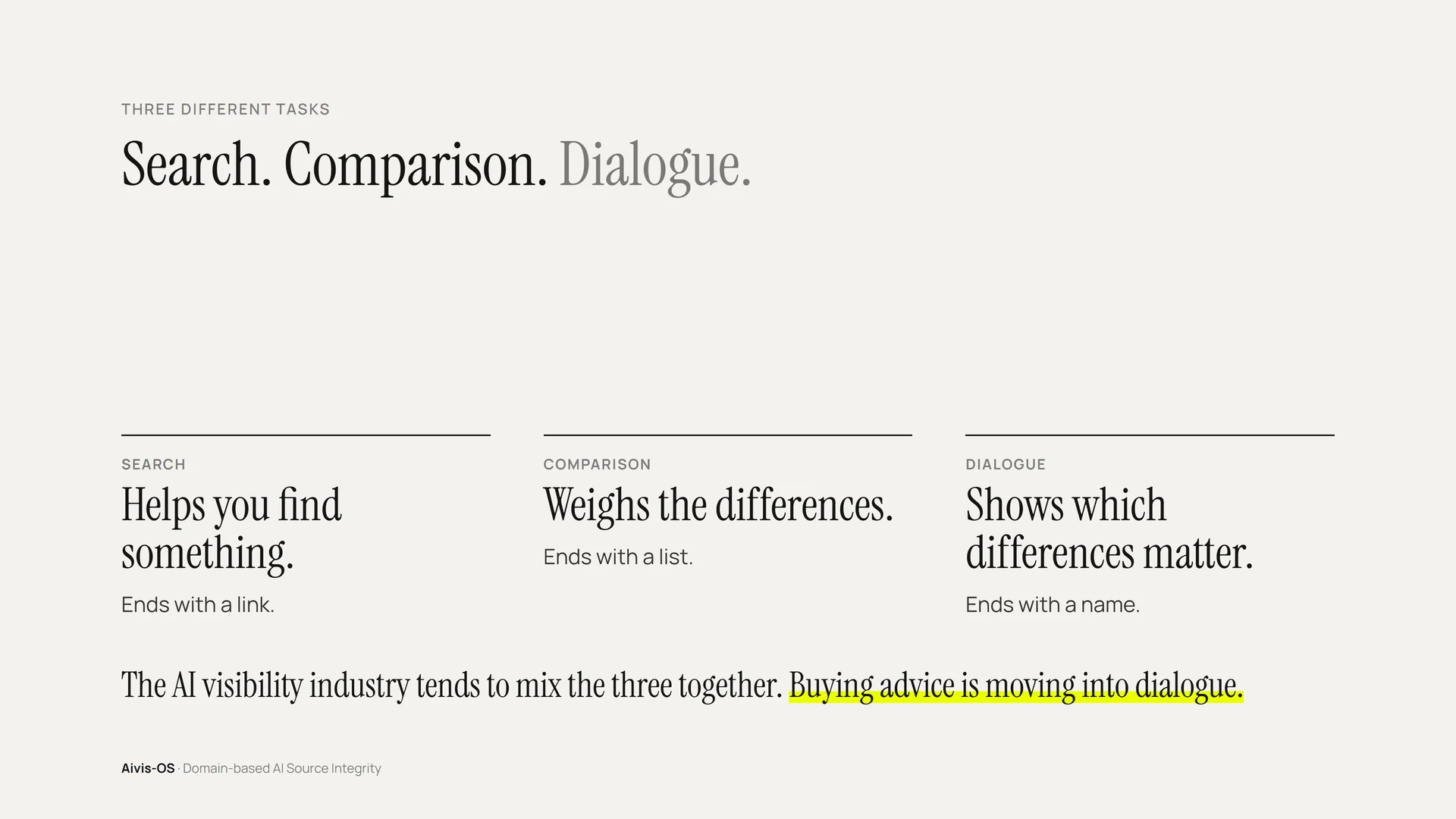
Search, comparison, and dialogue end differently: with a link, with a list, with a name.
How far has this change already progressed?
In a 2026 G2 survey, half of the B2B software buyers surveyed now start their research more often with an AI chatbot than with Google. In the previous year’s survey, it was 29 percent. Every third person, influenced by an AI chatbot, chose a provider in their last selection that they had not previously considered. And according to Forrester, 94 percent of business buyers surveyed use AI in the purchasing process. These are surveys, not revenue measurements. However, they show where purchase advisory is moving.
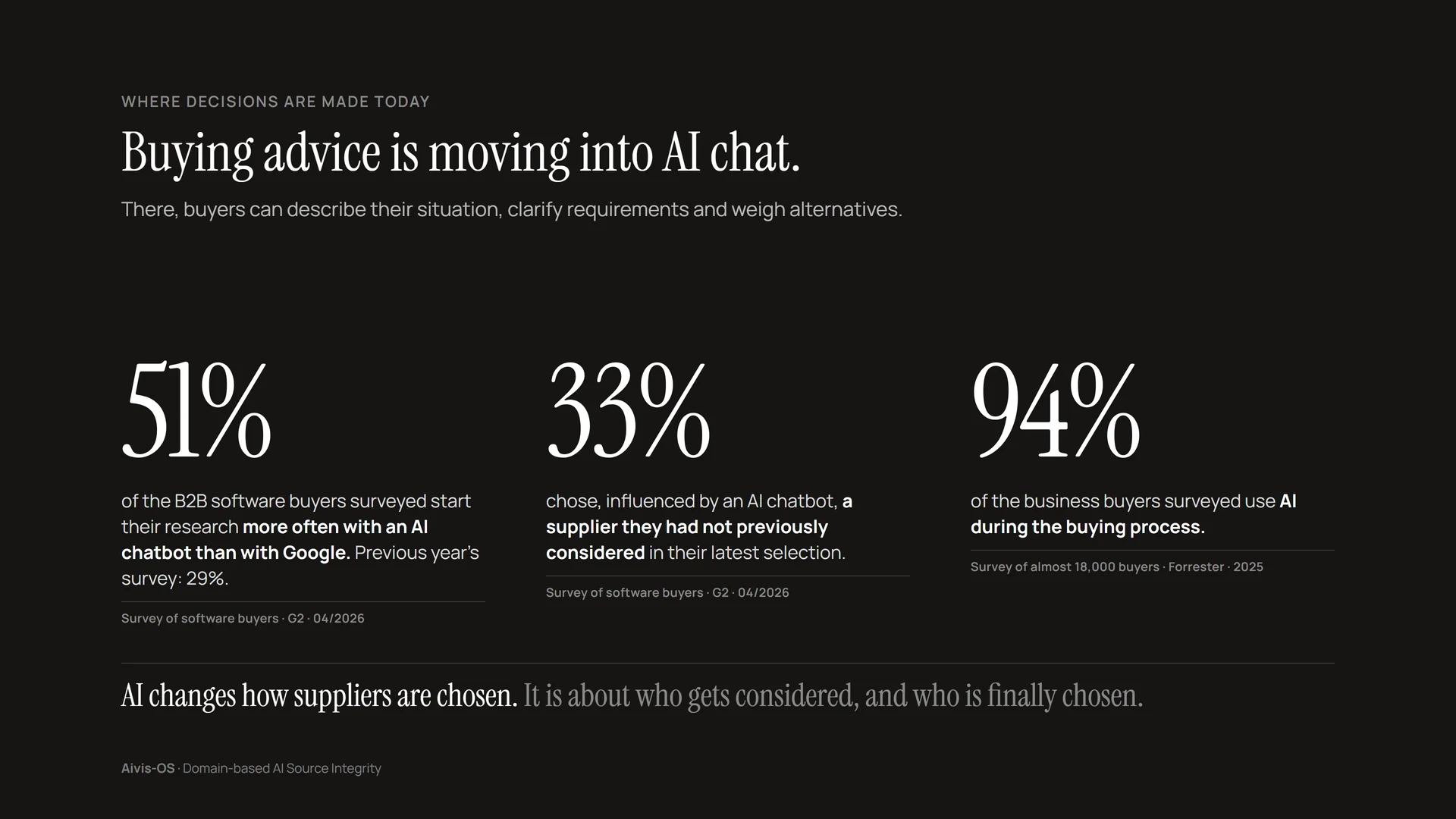
Surveys by G2 (04/2026) and Forrester (2025 survey, published 01/2026).
The selection changes with every follow-up question
Two studies by AI visibility providers show how much. In 1,200 simulated B2B software purchase dialogues, only 19 percent of the brands from the first response were still mentioned after eight questions. In simulated consumer dialogues, the AI almost always recognized a brand mentioned by the buyer. In the final decision round, however, it recommended this brand in only about 13 percent of cases.
Both are simulations, not observed purchases. And there is a valid objection: many people stop asking after the first response. So the first response counts. It just isn’t enough. Being known, being mentioned, and being recommended are different things.
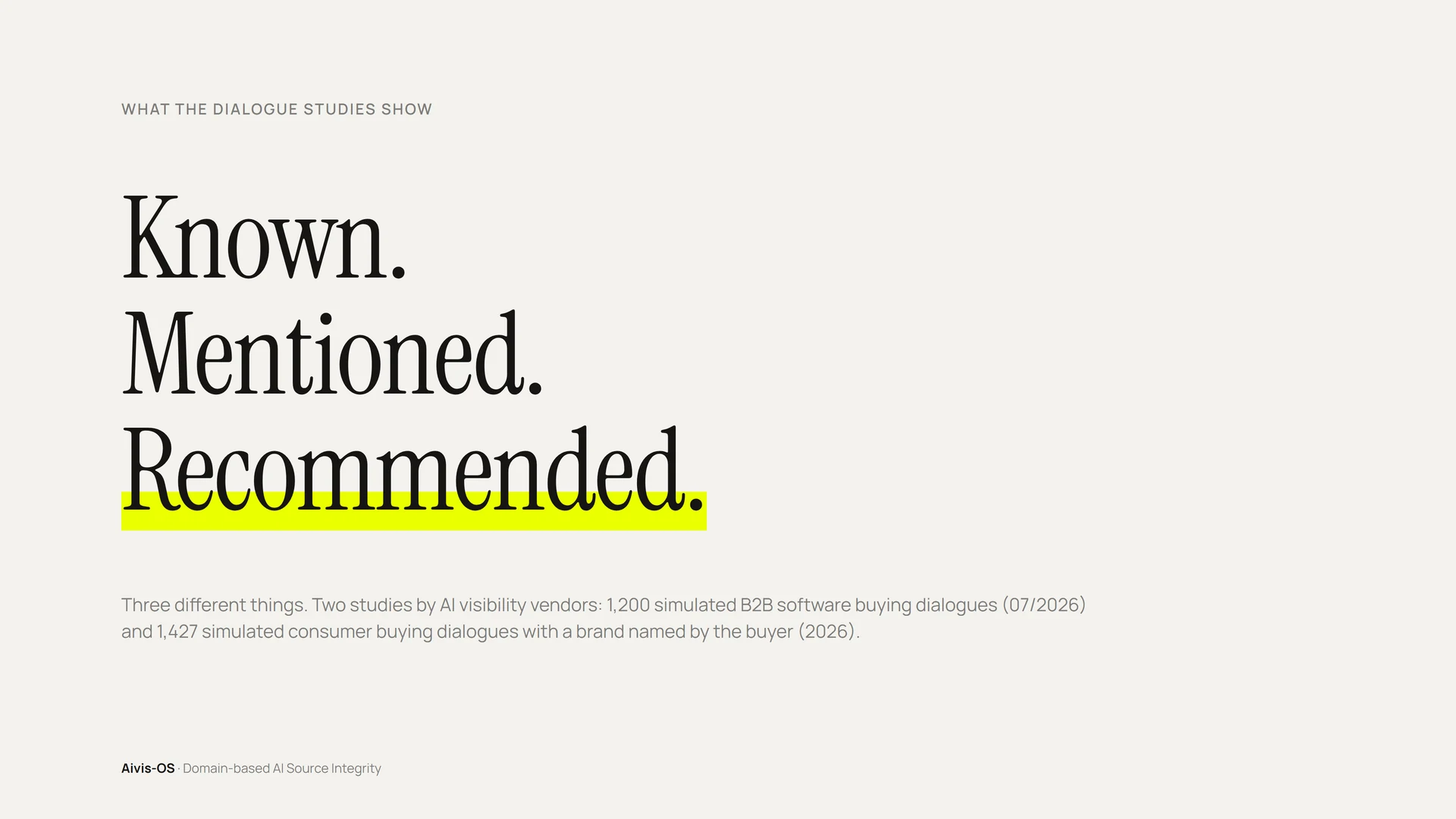
Two provider studies, 2026: 1,200 simulated B2B software purchase dialogues and 1,427 simulated consumer dialogues with a brand mentioned by the buyer.
What we haven’t measured ourselves yet
A clean, documented dialogue sample of our own – eight to ten questions, recorded response by response, asking at which point a company drops out and what information was missing there – is something we have only planned so far. Until then, we rely on the studies above and our own samples. What we can check, however, is the other side: whether your website clearly answers the late-stage questions. Why standard measurements don’t show this is described in the article “Why AI monitoring stops after the first question”.
Conclusion
A mention is a beginning, not a result. In conversation, the list becomes a selection, and the one who fits the described situation is selected – provably, clearly, and findably. Those who only count how often they are mentioned are counting tickets. What matters is whether you are still in the room when the door closes.
More articles
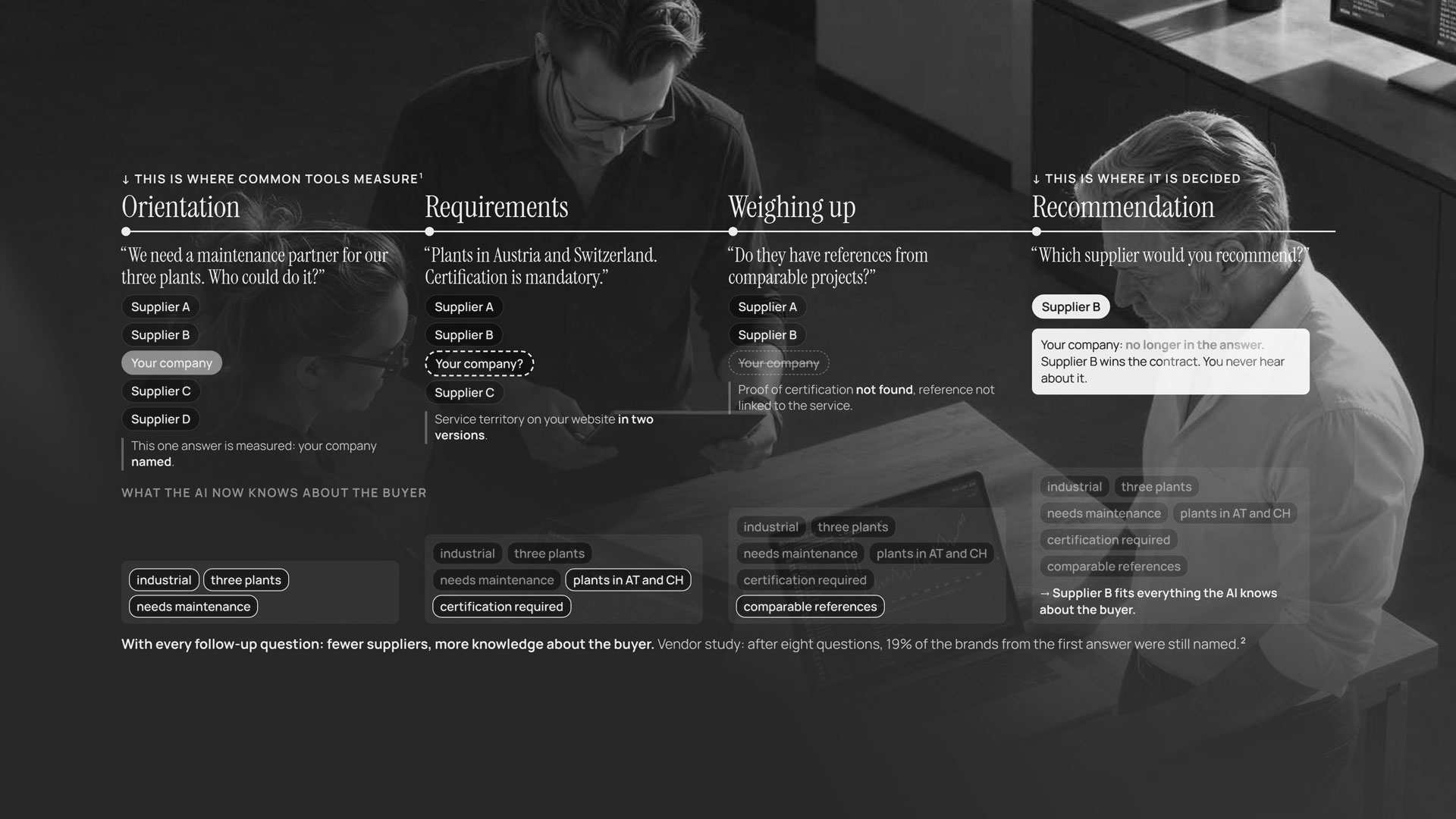
Mentioned in the first response, no longer in the last

Why AI Monitoring Stops After the First Question

Known or Suitable: What Differentiates Established Companies and Specialists

When Structured Data Publishes Contradictions

Who’s speaking? What machines learn from your website today

Source First, Then Echo

Your people decide. They don’t type.

Domain-based structured data: eight benefits

Acceptance, Not Report: Objective, Boundary, and Completion
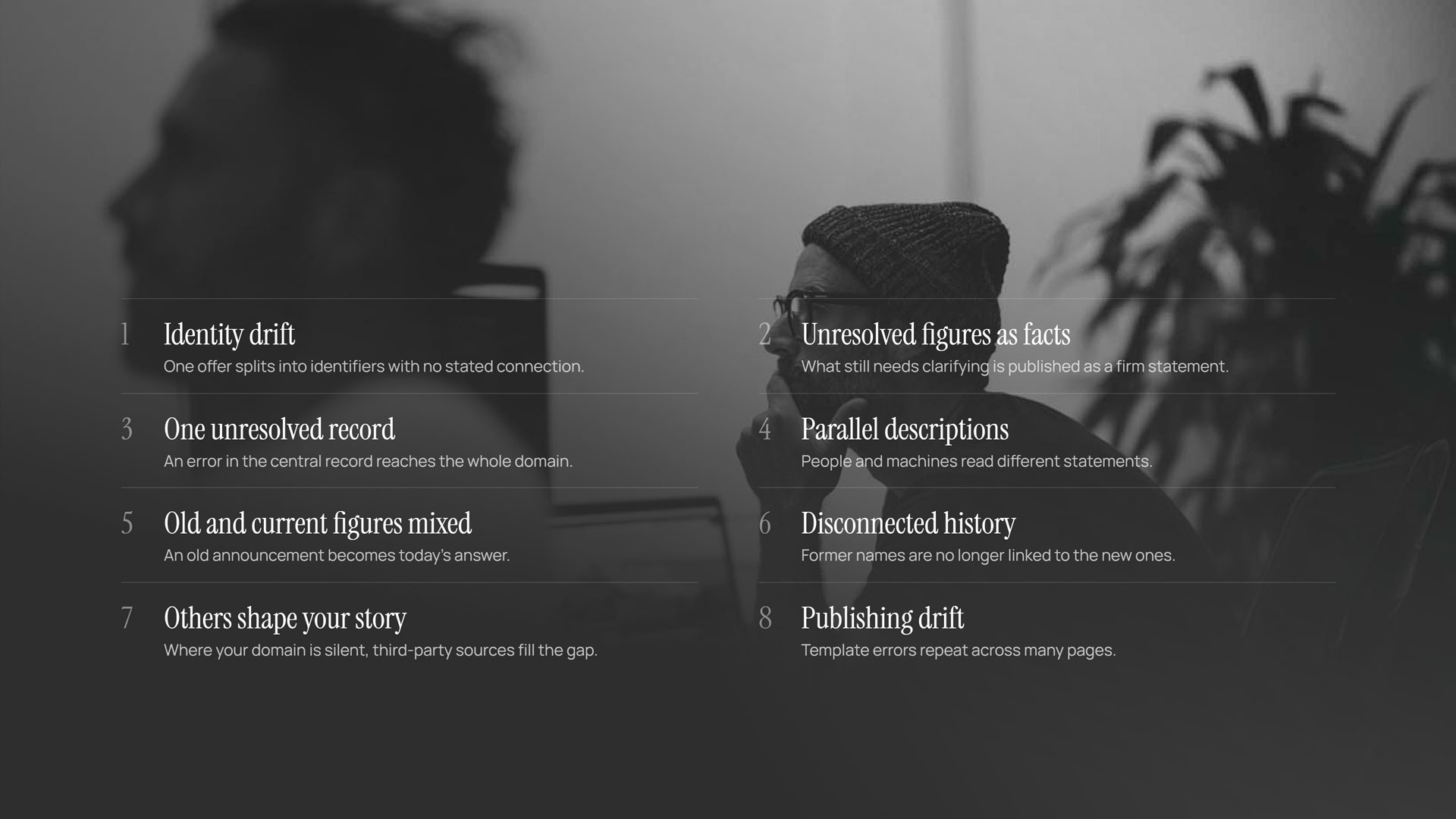
Page-generated data: eight risks
FAQ
Is it enough to be mentioned in AI responses?
No. The first response is often for orientation. Recommendations are made later in the conversation when the buyer states their requirements. That is when it matters whether your offer demonstrably fits.
Where do the figures on buying behavior come from?
From surveys by G2 (B2B software buyers, 2026) and Forrester (business buyers). The dialogue figures come from two studies by AI visibility providers using simulated dialogues.
Is the maintenance example a real case?
No, it is an illustration. The samples from our work are real: three questions for a provider in the travel market and an AI research session conducted in German and English on the same day during an audit.
Contact us to discuss your project or simply get our opinion.