How the list came about
In an audit, we were faced with a large website with structured data on a great many pages. Technically, much of it was cleanly solved, and the company itself was maintained under the same central identifier across all pages. And yet, in many places, the data told a different story than the visible text—or it stayed silent where the text spoke.
To explain what was missing, we needed a benchmark. We asked ourselves: What would domain-based structured data do differently at exactly this point? That became eight benefits—and, on the other side, eight risks, which we describe in a separate article. Since then, we have worked with this comparison in audits. The examples below are generalized.
The condition upfront
Domain-based means that companies, people, products, and facts are maintained once for the entire domain, and each page receives the relevant part from it. All eight benefits depend on one condition: the facts are settled before they are structured.
1. Identity
A product remains the same across markets and languages. In that audit, one product carried multiple identifiers under different names, with no connection between them. Domain-based, it carries one identifier, on every market and language page.
2. Consolidated evidence
Every mention points to the same entity: every reference, every announcement, every expert article. There, a product was mentioned on many pages but connected to it in the data on only a few. If a buyer asks for references, the AI then has to first reconstruct which evidence belongs to it.
3. Unambiguous facts
A released value applies per context. A single test gives a clue as to why this matters: where a website was unambiguous, an AI reproduced all 13 checked statements correctly; where it contradicted itself, eight of 13 were vague, outdated, or wrong.
4. Facts with their context
Every number carries its effective date and states what it counts. Two different headcounts are then no longer contradictions, but two reporting dates or two counting methods that are identifiable as such.
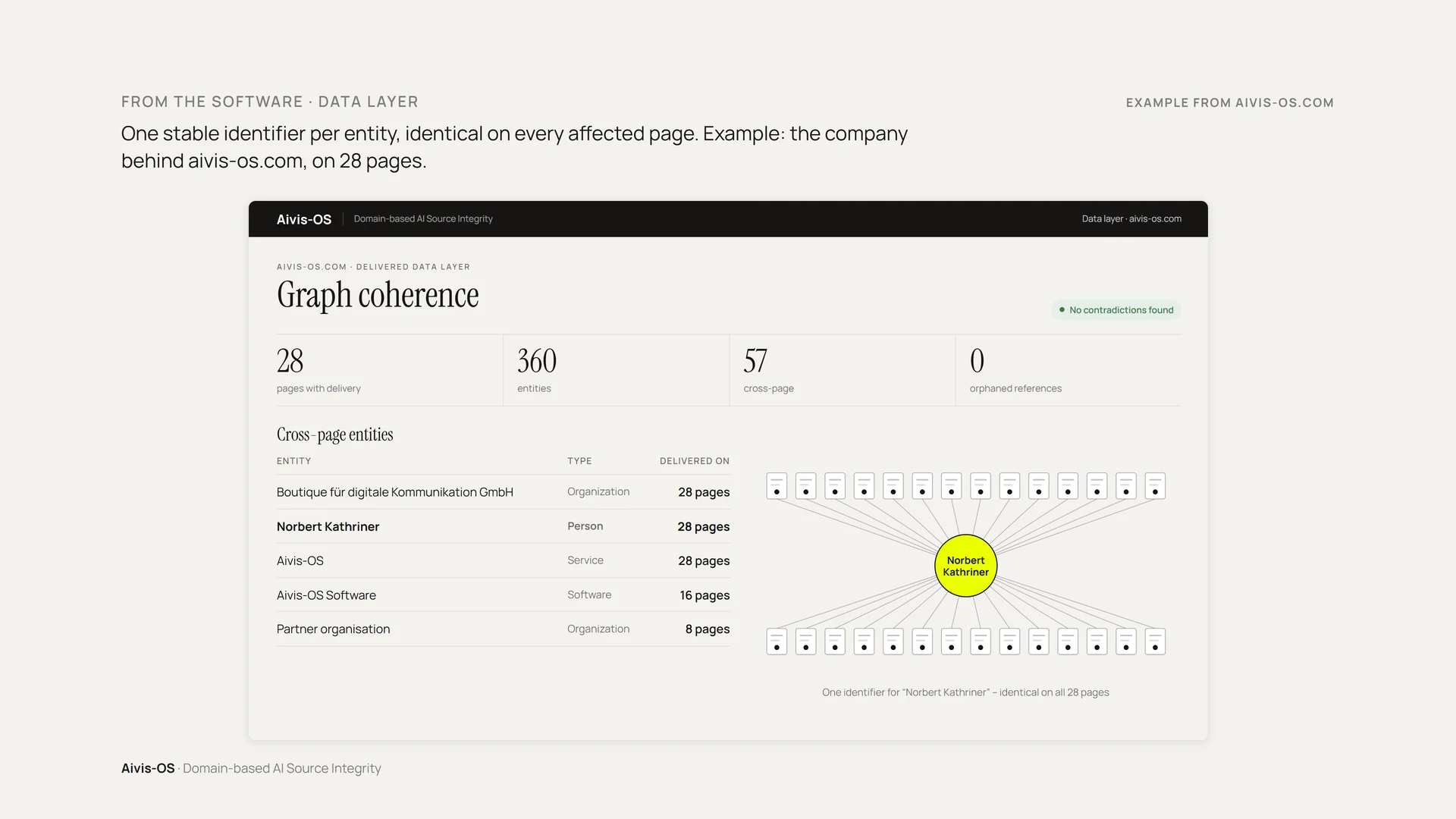
Example aivis-os.com: One entity carries the same identifier on 28 pages (as of October 2026).
5. Content and relationships
The data states who and what a page is about. In that audit, the website introduced a whole series of people; in the structured data, not a single person appeared. Domain-based, an acquisition is not just text in an announcement, but a relationship between two companies with a date, and a person is a person.
6. External anchors
A registry number distinguishes companies with similar names; a brand name alone cannot. Where available, entities are linked to registries, Wikidata, or Wikipedia—as anchors, not as a source for values.
7. Changes from a single source
A renaming is maintained once in the shared inventory and propagated to all variants. Because the company in that audit was maintained centrally, a correction there would have taken effect immediately on all pages. Honestly: on our own website, at the start of October we still had to adjust a role individually on 28 data objects, because our delivery is file-based. We’re working on that too.
8. Traceability
Every statement leads back to its source and approval. If the central description diverges from current positioning, this can be found before it is published—if someone looks for it. On our own homepage, exactly that took too long.
What happens when the condition is not met is described in the article “Page-by-page generated data: eight risks”.
Conclusion
Domain-based data does not describe pages, but what the pages talk about: companies, people, products, facts, and their relationships—settled once, the same everywhere. Its value depends on the order: decide first, then structure. Then many versions become one truth that a machine does not have to guess at.
More articles
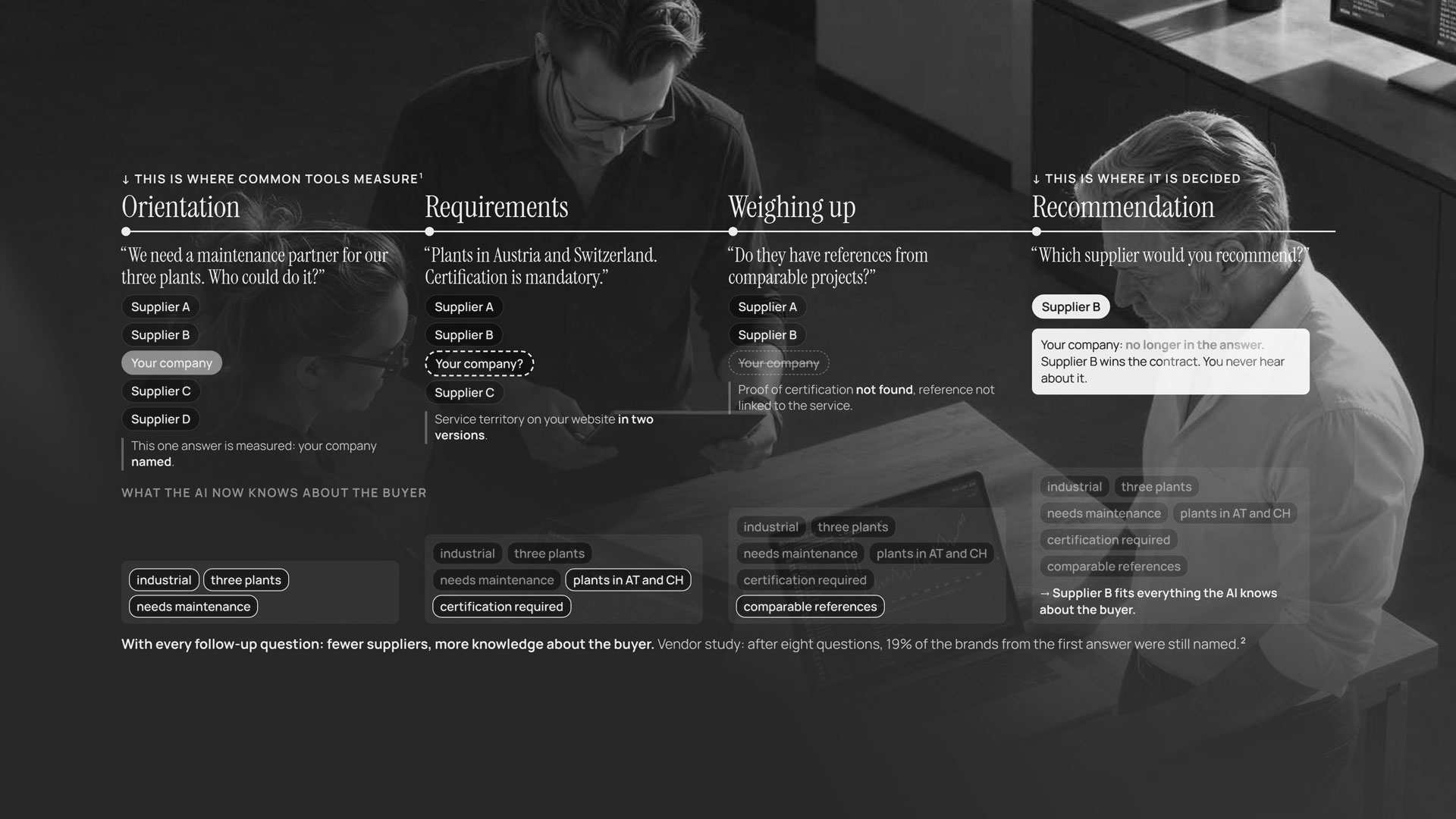
Mentioned in the first response, no longer in the last

Why AI Monitoring Stops After the First Question

Known or Suitable: What Differentiates Established Companies and Specialists

When Structured Data Publishes Contradictions

Who’s speaking? What machines learn from your website today

Source First, Then Echo

Your people decide. They don’t type.

Domain-based structured data: eight benefits

Acceptance, Not Report: Objective, Boundary, and Completion
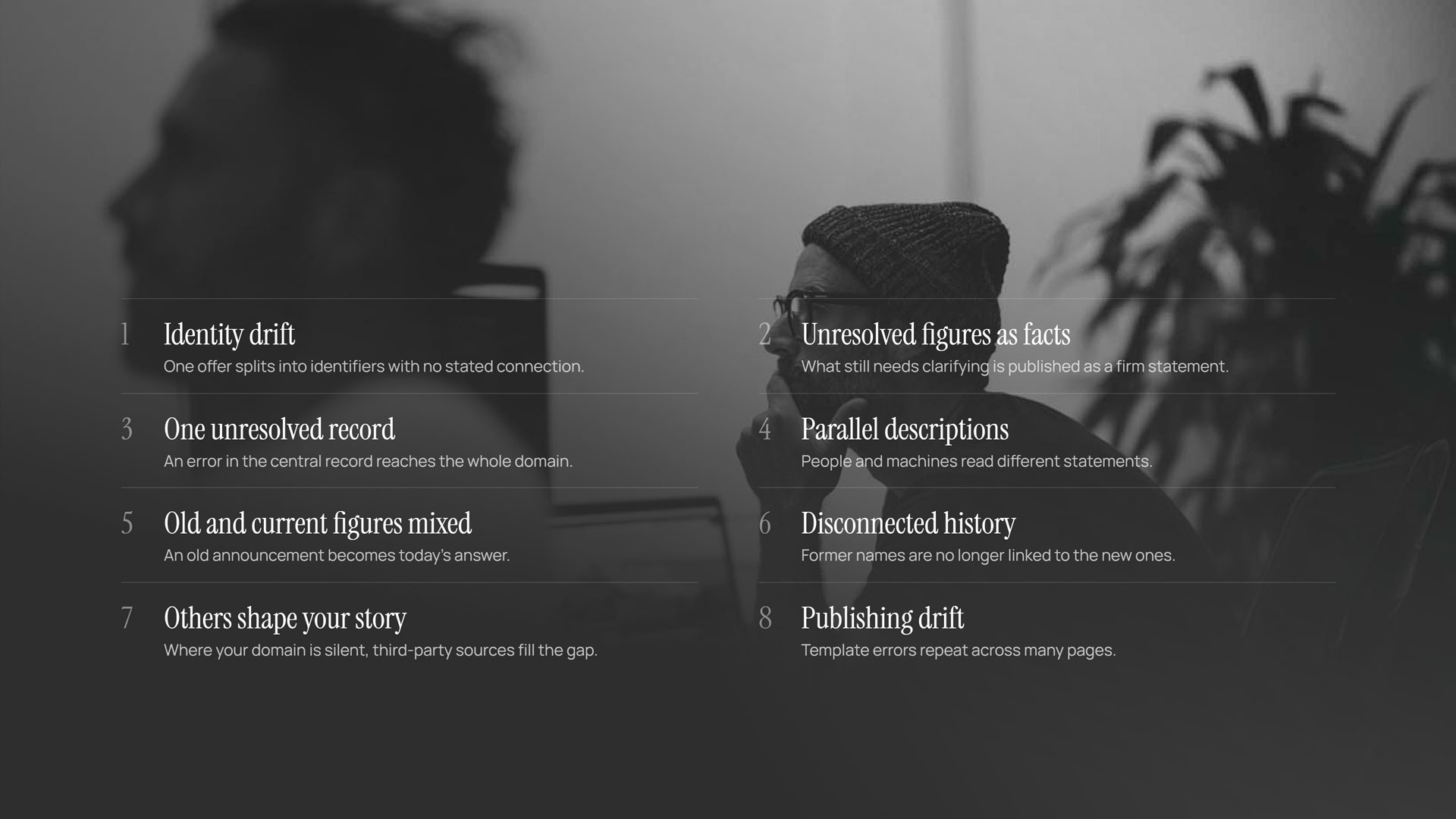
Page-generated data: eight risks
FAQ
What distinguishes domain-based from page-based data?
Page-based data describes each page in isolation. Domain-based data maintains each entity once with a fixed identifier, and each page references it.
Do you need a knowledge base for this?
You need a shared, settled inventory. What matters is less the technology than the sequence: decide first, then structure.
Where do the examples come from?
From audits of Aivis-OS and of our own website. The examples from client audits are generalized and allow no conclusions about individual companies.
Contact us to discuss your project or simply get our opinion.