When an AI estimated our prices
In August, we asked an AI what Aivis-OS costs. At that time, our prices were not yet on the website. The answer came anyway: 6,000 to 12,000 euros one-time, plus 150 to 300 euros per month. Where the numbers came from remained unclear. They did not originate from us.
We drew a simple conclusion and published our prices. The bigger question remained: If gaps are filled by others anyway – shouldn’t you go external first, into technical articles, directories, and mentions?
External sources count – a lot
The question is valid. According to Muck Rack (May 2026), 84 percent of AI citations originate from third-party editorial sources; according to AirOps (2026), 85 percent of brand mentions come from external domains. In our own sample for a travel market provider, several answers relied on comparison portals; the provider’s website was cited by only one of the systems. Ignoring external sources would therefore be wrong.
But it depends on what they propagate. And that is where the problem begins.
What happens when your own source offers two versions
In one audit, a website cited two different values for the same metric in different places. The AI took neither. It took a third one, from a PDF document.
If your domain offers two versions of your operational scope, a further technical article does not decide which one applies. It might simply propagate both. And even if buyers never visit your website, your content is read and summarized. That is why your domain matters: it is the one source whose content you determine yourself.

An AI responds based on training data, third-party sources, and your website. You only have full control over your own domain.
External anchors also require verification
Even the references intended to make a company unique via structured data can be off-target. In one project, we had linked a data product to a Wikidata entry of the same name – which described a broadband product from a completely different industry. The name matched, the entity did not. In another, a company’s Wikidata entry listed an incorrect headquarters. Since then, our rule is: external entries are anchors to uniquely identify a company. We do not consume values from them without verification.
Fill the gaps first
Back to your own source. Gaps are not filled on suspicion, but scenario by scenario – before external sources are aligned. An example: An industrial client is looking for a maintenance partner for three plants, two of them in Austria and Switzerland. Once the operational scope is clarified, their next question might be: What happens if a plant fails at night? What response time applies to which plant? A clarified operational scope does not answer these questions. The missing answers are obtained, approved by those responsible, and added.
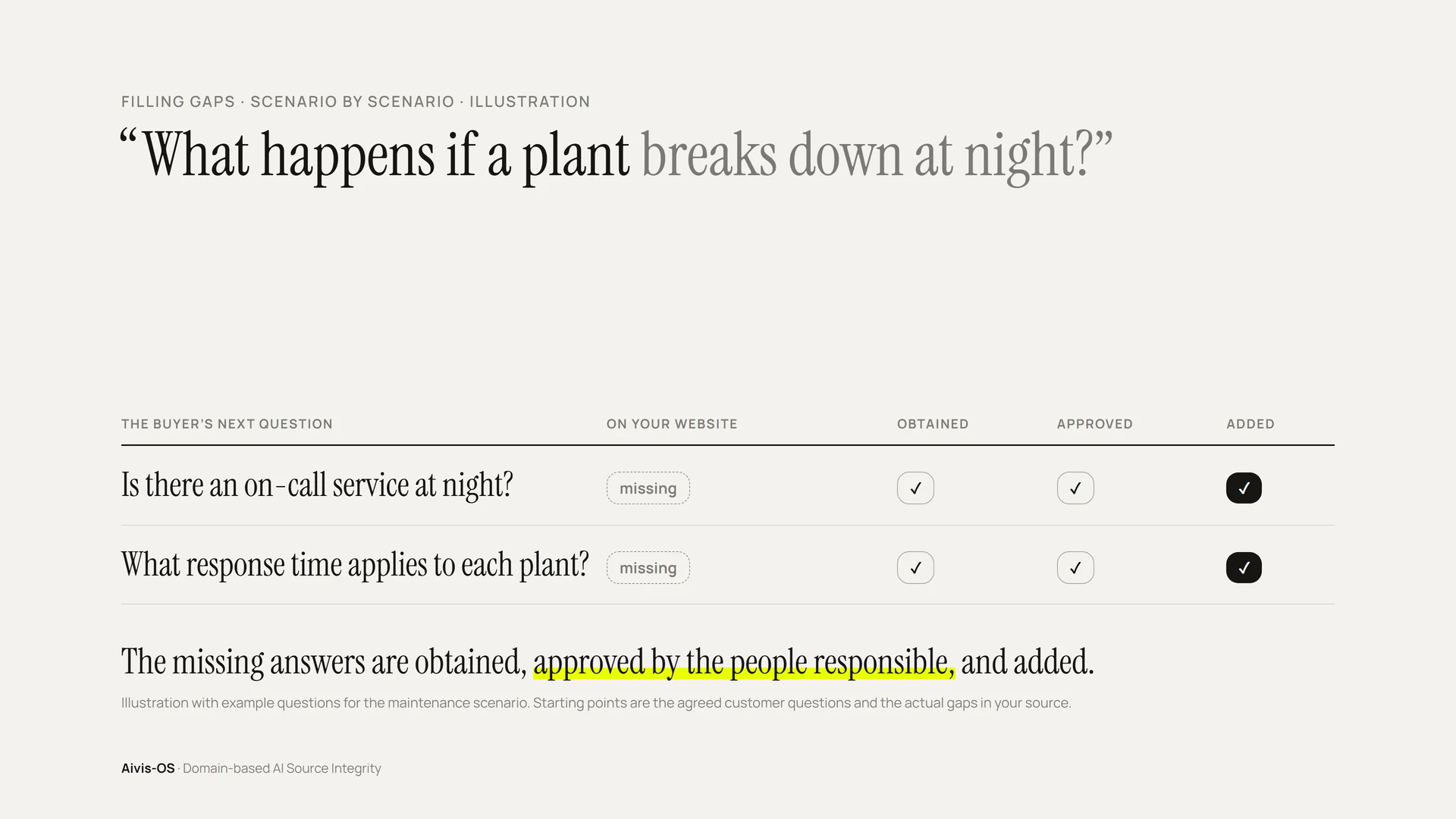
Illustration: Missing answers to specific buyer questions are retrieved, approved, and added to the website.
Then the echo
Only then are directories and profiles aligned with the approved version, where agreed. Partners and platforms can carry the information further, even to places where you have no direct access. Good SEO and GEO work (optimization for AI responses) remains useful. It just needs a source it can build on.
Conclusion
Gaps do not stay empty. Those who do not state their prices get estimated ones. Those who offer two versions might get a third. External sources amplify what they find. Therefore, clarify and complete your own source first. Source first. Then the echo. Those who propagate before clarification propagate their contradictions.
More articles
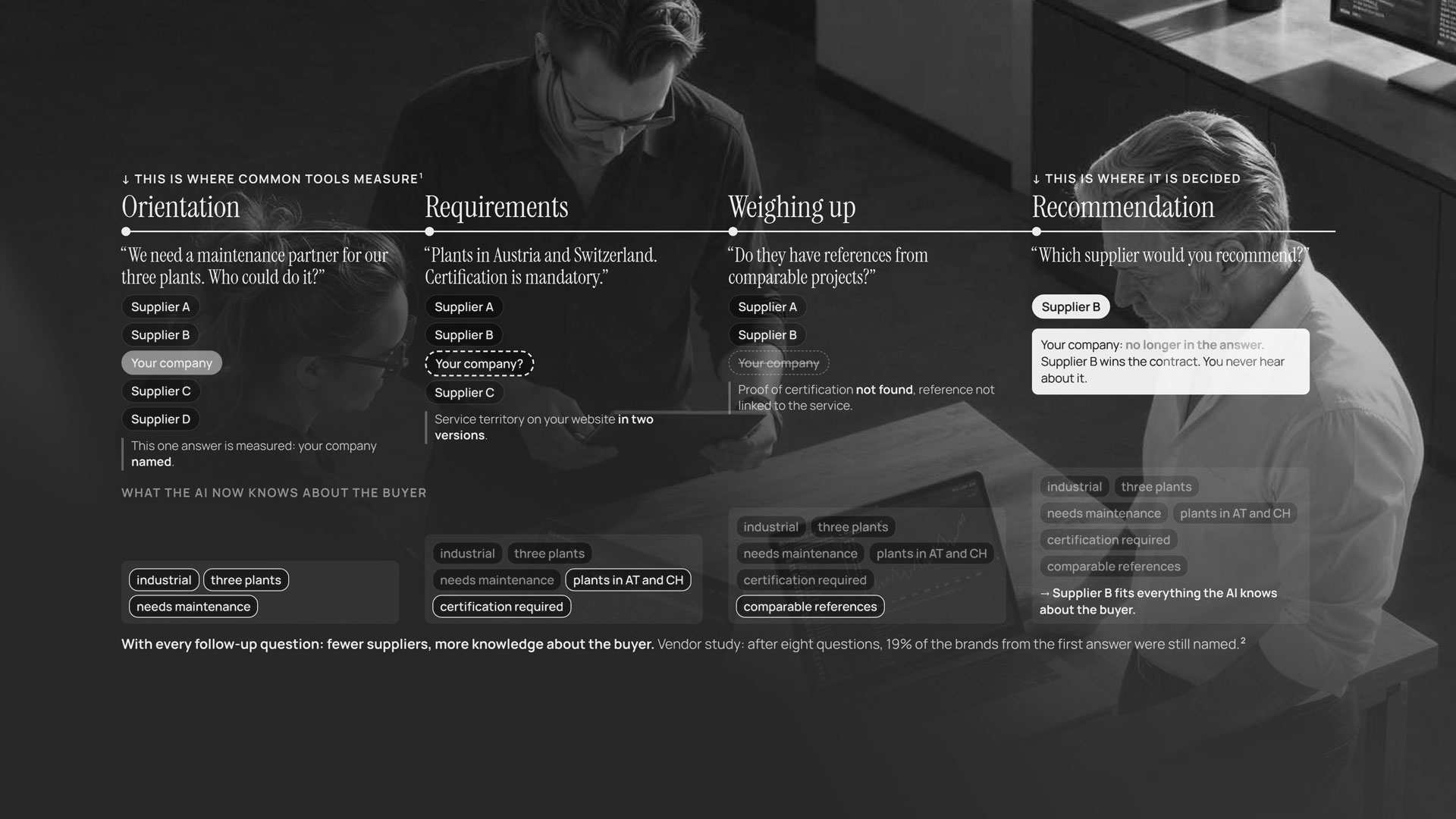
Mentioned in the first response, no longer in the last

Why AI Monitoring Stops After the First Question

Known or Suitable: What Differentiates Established Companies and Specialists

When Structured Data Publishes Contradictions

Who’s speaking? What machines learn from your website today

Source First, Then Echo

Your people decide. They don’t type.

Domain-based structured data: eight benefits

Acceptance, Not Report: Objective, Boundary, and Completion
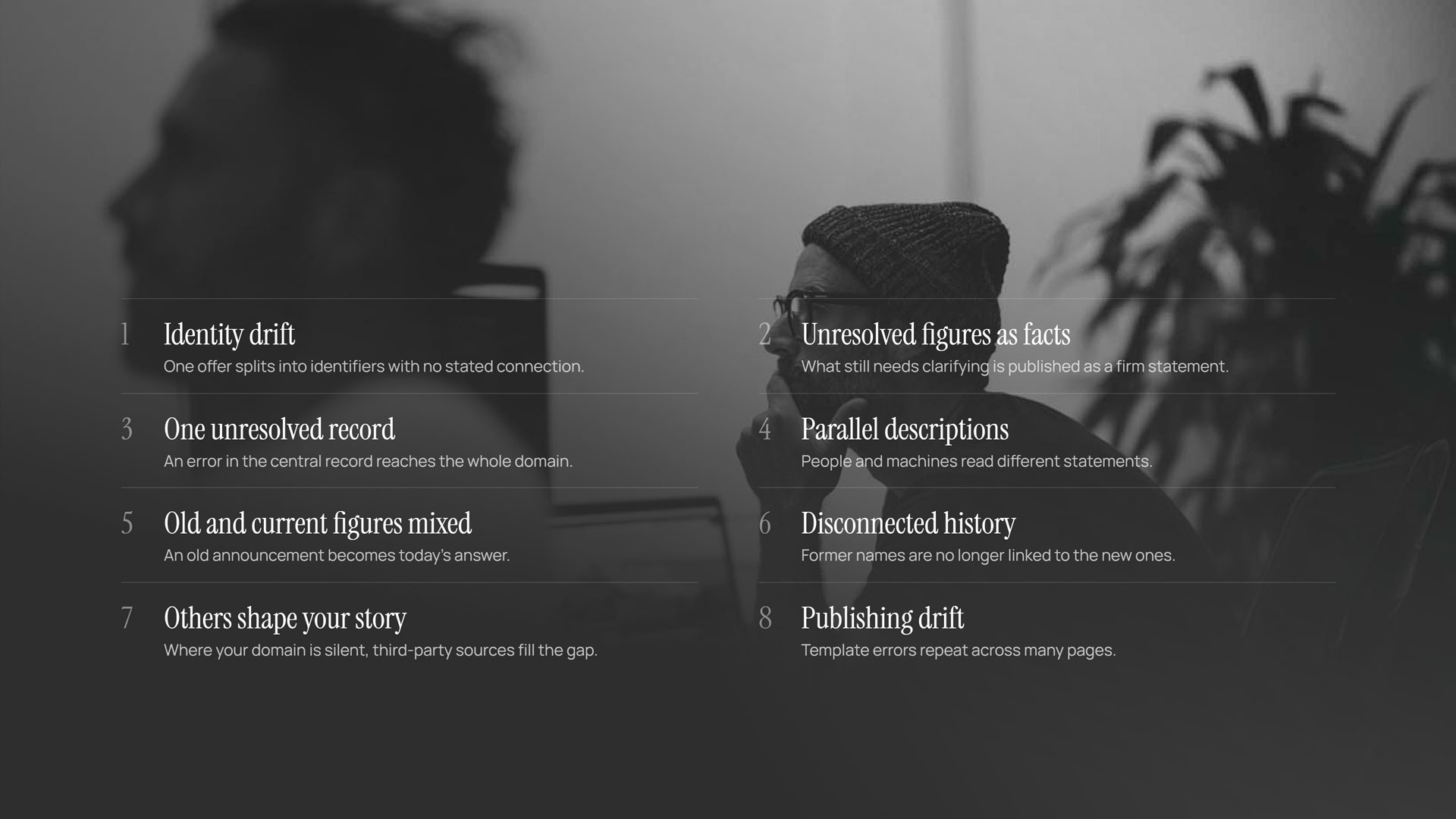
Page-generated data: eight risks
FAQ
Are external sources unimportant?
No. Technical articles, press, and links help, and AI systems cite them frequently. However, they can only propagate what has been clarified. Otherwise, contradictions on your own domain are propagated along with them.
Why does the own website matter if buyers never visit it?
Because AI systems read and summarize your content regardless. Your domain is the only source whose content you determine yourself.
What is a scenario?
A specific buyer question including everything necessary to answer it, such as on-call service and response time per plant for a customer with multiple locations.
Contact us to discuss your project or simply get our opinion.